Manifesto
2026-06-28
Finance Engineering
Orchestration of processes rather than their execution
With the AI wave, there's an acceleration towards automation. People are more enabled than ever to build and leverage the use of software. As a result, it is no surprise to find more hybrid roles, where the foundational skills are leveraged with the direct use of Engineering, Data, and AI.
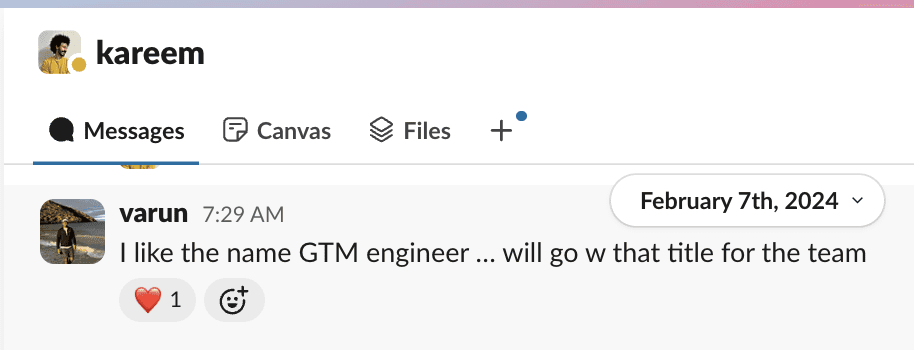
Clay coined the GTM Engineer (GTME) role in 2023, and currently, 100 GTME job listings go live each month.
Why? Because the role is a true enabler. Exponential growth through the right tools.
According to their definition, "GTM engineering is the practice of building automated revenue systems using AI, data enrichment, and workflow automation."
But we are not here to talk about GTM Engineers, are we?
Finance Catch Up
Traditionally Finance / Ops have been a department in the back-burner. Reactive to the organisation processes, constantly trying to catch up. This has been the case because:
- Finance / Ops teams don't have time left after the day-to-day work;
- Business Intelligence depends on the conclusion of the day-to-day operations (e.g. Month End)
- The extraction of the data is not always straightforward and, usually, requires a Data Team.
Introducing the Finance Engineer
Similarly to Clay, CFO Connect coined this year the Finance Engineer role.
Their definition follows: "A Finance Engineer is a finance professional, whether Controller, FP&A lead, Head of Finance, or CFO, who has added technical fluency and a build-first mindset to their existing finance foundation."
In my view, it is the move towards the orchestration of processes rather than their execution. It is a stack of foundational skills (Finance) with Engineering, Data, and AI.
Specifically, a Finance Engineer is focused on:
- Data Integrity & Governance: maintaining the same data definitions across or within systems
- Systems Integrations: build and maintain connections between business systems, either via API Protocols, native integrations, or through the usage of automation software
- BI & Analytics: Making broadly available the raw or derived data
- Backend: Getting the data out of the systems into a centralised data warehouse and prepare tables that will be consumed by the frontend
- Frontend: Creating dashboards and reports
This solves the Finance and Ops' bottlenecks, as in:
- Time is saved on the day-to-day operations by Systems Integrations and Data Integrity & Governance
- Business Intelligence is faster as a result, since teams aren't waiting on manual reconciliation.
- BI & Analytics enable the extraction and analysis of data, removing the dependency of a Data Team
The workflows can be powered up by AI, where needed, but a lot of the low hanging fruit is about making systems talk to each other (integration) and the same language (same data definitions across the tech stack).
What's next
An Ops and Finance Team can reap huge gains by stacking Engineering, Data, and AI skills onto their existing processes.
This is the space I'll be building out here: the tools, the workflows, and the messy parts in between.
Follow along.